Texas City homeowners call us about KitchenAid refrigerators, ice makers, dishwashers, ranges, wall ovens and older laundry pairs. Phone or use our site, and the visit generally falls on tomorrow.

Local housing, power events, water conditions, and installation styles all affect how we approach KitchenAid diagnostics here.
The townsite plat went on record in 1893, with city status arriving in 1911. Refineries and the port nearly doubled the population in the 1950s, from 16,620 to 32,065, which explains the many postwar houses.
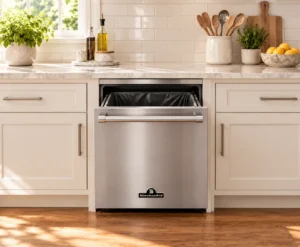
Kitchens from that period are snug, so a current KitchenAid dishwasher or wall oven must fit openings cut decades ago. Give us the house's age and trim kits and fittings come along.
Texas City is home to the Thomas S. Mackey plant, where Brazos River water is treated for the Gulf Coast Water Authority. The facility began as a municipal plant able to handle 18 million gallons a day, and the city still buys from the authority.
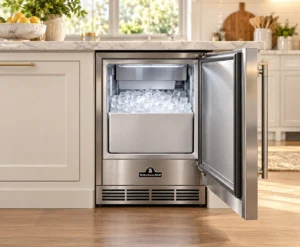
Brazos supply carries enough minerals to scale a KitchenAid ice maker and dishwasher over the years. Before replacing anything we test the filter and hardness setting.
After Carla in 1961 the city built protection that includes a 23-foot seawall, finished in 1985, and an inner levee eight feet high along Moses Lake, with pump stations. Within that ring, what harms appliances every day is wet, salty air.
Moisture works on refrigerator gaskets and condenser fins. Wiping them down and checking the coils keeps a KitchenAid compressor from laboring.
Postwar houses usually have small kitchens, a 24-inch dishwasher next to a freestanding range, and a washer and dryer in the attached garage. Newer ones have complete kitchens and counter-depth refrigerators.
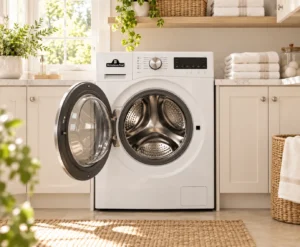
Garage laundry breathes damp, salty air all day, so its vent is the first thing to clog. Tell us where yours stands.
Mainland Galveston County has a next-day slot on our calendar, and we drive into Texas City on I-45 or Highway 146. Anyone at home who sleeps after night shifts should say so on the call, since we then lean toward the 1-4 afternoon window. Any gate code or tight parking on your street is worth mentioning too.
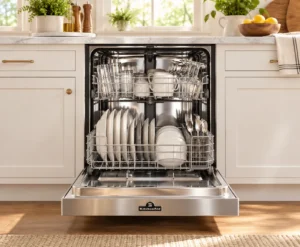
Dishes that come out wet usually trace to empty rinse aid, a dried-out vent or a heating element worn down by years of salty air. Fill the rinse aid, run the heated dry setting once and look at the tub bottom for standing water before booking. If the element shows no heat, we test it and the control, and a dishwasher that dies with the breaker tripped should be checked by an electrician first.
Yes. Say so at booking, and we schedule an afternoon arrival instead.
Not always. Empty rinse aid or a clogged vent often causes it. We check those, then test the heating element and give you the cost before replacing it.
Often yes, since many parts for older refrigerators, dishwashers and ranges are still available. After diagnosis we state the part and labor cost so you can decide.